Euclid Flagship mock galaxy catalogue
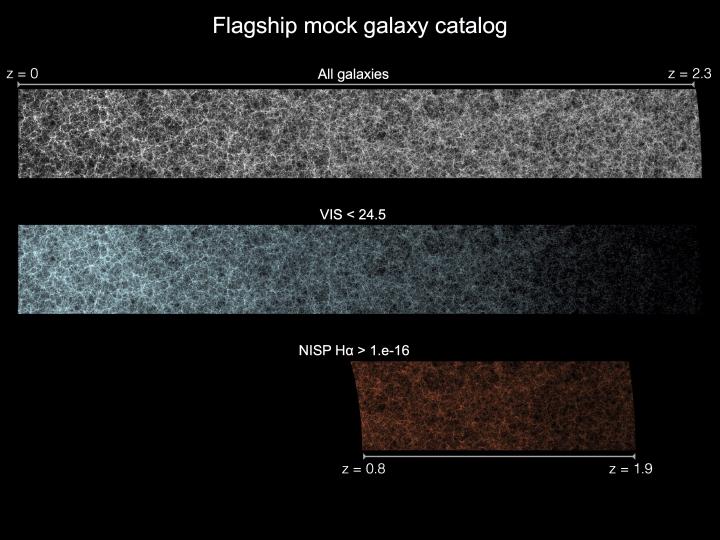 Credit: J. Carretero, P. Tallada, S. Serrano for ICE, PIC, U.Zurich and the Euclid Consortium Cosmological Simulations SWG
The cosmological analysis of galaxy survey data requires modelling the large scale distribution of galaxies in synthetic realisations of the sky that are usually referred to as mock galaxy catalogues. These provide a controlled environment in which to test the impact of different aspects of the survey and allow to study the interplay of observational and statistical errors. For this reason they need to cover the same volume of the survey and to be statistically compatible with observed galaxy catalogues.
During my position at the Institute of Space Sciences in Spain I developed algorithms to generate such catalogues, building upon the expertise of the members of the MICE collaboration. We worked in close collaboration with PIC, the Spanish Euclid Data Centre, where a dedicated Big Data platform was installed, and produced a pipeline that is able to consistently generate dozens of observed properties for extremely large volumes in a timescale of a few hours ( Carretero et al. 2017). This represented a significant improvement compared to previous implementations that required several days to be completed and were not automated, making them more prone to human errors. Being able to produce several iterations of the mocks in the span of a few days will also be crucial for the analysis of Euclid data.
This pipeline was first deployed to generate the Euclid Flagship galaxy mock, the largest ever produced, with 2.6 billion objects, more than 100 galaxy properties and covering a redshift range up to z=2.3 ( Euclid Collaboration: Castander et al. 2024). Our team won the 2018 Euclid STAR Prize for this work. My role in this team has been the re-factoring of the code to take advantage of the Big Data platform both in the calibration and production phases.